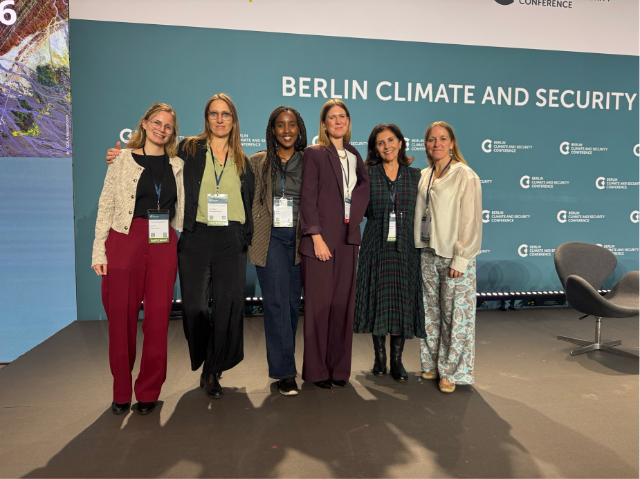
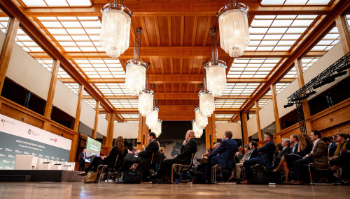
At this year’s Berlin Climate Security Conference, Berghof challenged policymakers and practitioners to look beyond the rhetoric and focus on what works.
|
|
________________________________________________________________________________
|
Climate security, resilience and finance
Key takeaways from the Berlin Climate Security Conference
|
|
________________________________________________________________________________
|
"We are experts in finding the right words, but words need to be followed by action."
German Foreign Minister Johann Wadephul’s message at the opening of this year’s Berlin Climate Security Conference set the tone for the discussions that followed.
Climate change is increasingly shaping the conditions for peace and security, affecting livelihoods, infrastructure, natural resources and economic stability. At the conference, Berghof colleagues joined partners from diplomacy, defence, development, finance and beyond to consider how climate and conflict risks can inform programming, investment and conflict prevention—and what it takes to turn analysis into action.
Speakers and participants repeatedly emphasised the close connection between resilience and security. Effective climate action in fragile settings requires locally grounded, conflict-sensitive approaches, stronger partnerships and the right kind of finance.
Our contributions drew on lessons from integrated climate and peace programming, practical experience from Somalia and approaches to financing climate action in conflict-affected settings. Together, they offered insights into what needs to change, who needs to act and what might stand in the way.
Read on for highlights from the conference and key takeaways from our colleagues and partners.
|
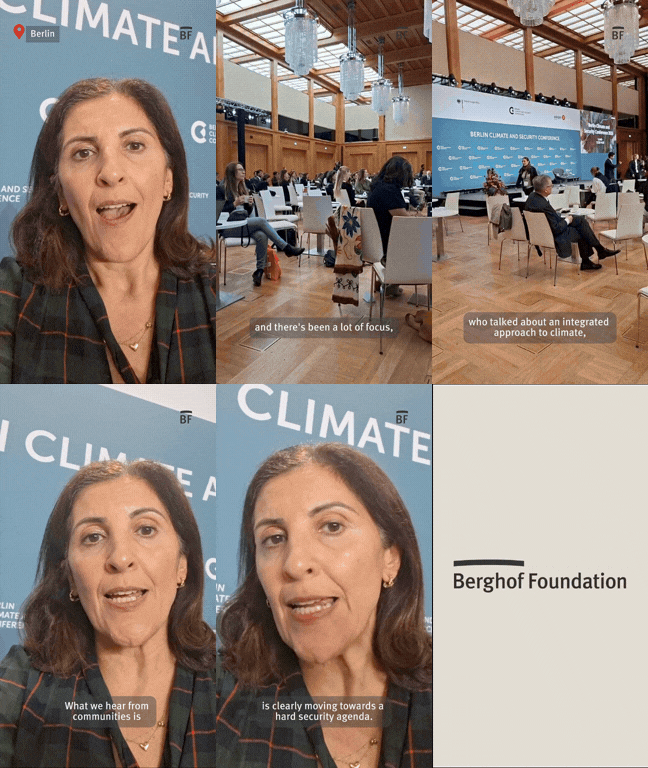 |
At the Berlin Climate Security Conference, our Senior Climate & Peace Advisor Nazanine Moshiri explains why strengthening security must go hand in hand with investing in resilience and development, and why stronger partnerships and practical financing are needed to turn climate risk assessments into action.
|
Lessons on integrated climate, peace and security programming from the Weathering Risk Peace Pillar
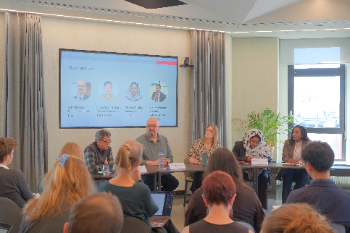
We were pleased to host a side event on the Weathering Risk Peace Pillar together with adelphi. The discussion focused on the need to better understand climate and environmental risks through a peace and conflict lens. A key takeaway was the importance of locally grounded, conflict-sensitive and adaptive programming that integrates peace and climate objectives from the outset.
|
|
"Peacebuilding without material change in living conditions eventually runs into a ceiling, while resilient infrastructure support without principled peacebuilding is eventually restricted in its capacity to transform societies." — Arrliya Sugal
|
Strengthening resilience and security through an HDP nexus approach in Somalia
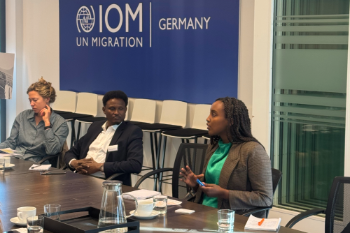
At our second side event, co-organised with IOM and SIPRI, our colleague Arrliya Sugal shared practical insights from Somalia, with our Head of Regional Peace Support Janel Galvanek moderating. Drawing on our work with IOM and UNEP in Jowhar since 2023, the session examined lessons from integrating conflict transformation, environmental restoration, community-led climate adaptation and resilient infrastructure, and what it takes to adapt this approach in other fragile, climate-vulnerable contexts.
|
|
Financing land restoration and climate action in conflict-affected settings
We explored how to make climate finance work in fragile and conflict-affected settings at our side event with the UNCCD’s Peace Forest Initiative. Featuring Janel Galvanek and moderated by Nazanine Moshiri, climate, peacebuilding, development, land restoration and finance communities explored how to move from reaction to prevention, put local actors at the centre, and design finance with conflict dynamics in mind. The UNCCD Peace Forest Initiative also introduced its proposed Fragility Financing Mechanism.
|
|
"As a community, we need to become more effective in communicating the consequences of inaction and making the case that investing in and addressing prevention, peacebuilding, and climate action together today is ultimately far less costly than responding to crises tomorrow." — Nina Strumpf
|
Climate action in conflict: Learning from local leadership
We hosted the Working Group on Peace and Development (FriEnt) and the Germany chapter of the Environment, Climate, Conflict and Peace Community of Practice (ECCP) for their side event bringing local perspectives from Bangladesh, Iraq, Sudan and Somalia. The need for context-sensitive climate action and finance was highlighted, including more flexible, longer-term funding, stronger access for local organisations, and greater support for existing local capacities.
|
|
Beyond the climate security conference room
In her latest blog, Nazanine Moshiri reflects on how climate security can move beyond conference rooms and translate growing recognition into practical action. She analyses the need to bridge climate, peacebuilding, development and security agendas, bring local actors, businesses and decision-makers into the conversation from the start, and ensure that climate-security discussions address the political choices and inequalities shaping who bears the consequences.
Learn more.
|
|
SUPPORT US
Invest in peace and help us ensure our impact is sustainable. We are looking for partners to support our work. When you donate to Berghof, you enable us to sustain and expand our work where it is most needed.
Whether through a single donation or recurring contribution, your support gives peace a fighting chance.
Learn more.
|
|
________________________________________________________________________________
|
Berghof Foundation Operations gGmbH, Lindenstrasse 34, 10969 Berlin, Germany
Data Protection Policy |
Imprint | You are receiving this email because you have subscribed to our newsletter or kindly donated to support our work. If you no longer wish to receive our emails, you can
unsubscribe.
|
|